


14
September
,
2026
•

Chris Walker

AI is changing how customers find, compare, choose and stay with brands.
For Australian SMEs, the question is no longer whether AI should be part of the customer journey. The better question is where AI agents can help customers take the next step, and where human support still matters most.
AI tools can answer questions, write content and analyse data.
AI agents go further.
They can follow a process, complete tasks, update systems, route enquiries, respond to emails, trigger workflows and support customers across different stages of the journey.
This is where the real opportunity sits for businesses.
AI agents can help connect your website, CRM, email platform, customer data, sales process, reporting and customer support. Used well, they can reduce manual work, improve response times and make the customer journey feel more relevant.
Used poorly, they can create confusion, over-automation and a weaker customer experience. No ones likes receiving emails with irrelevant information that has clearly been written by AI
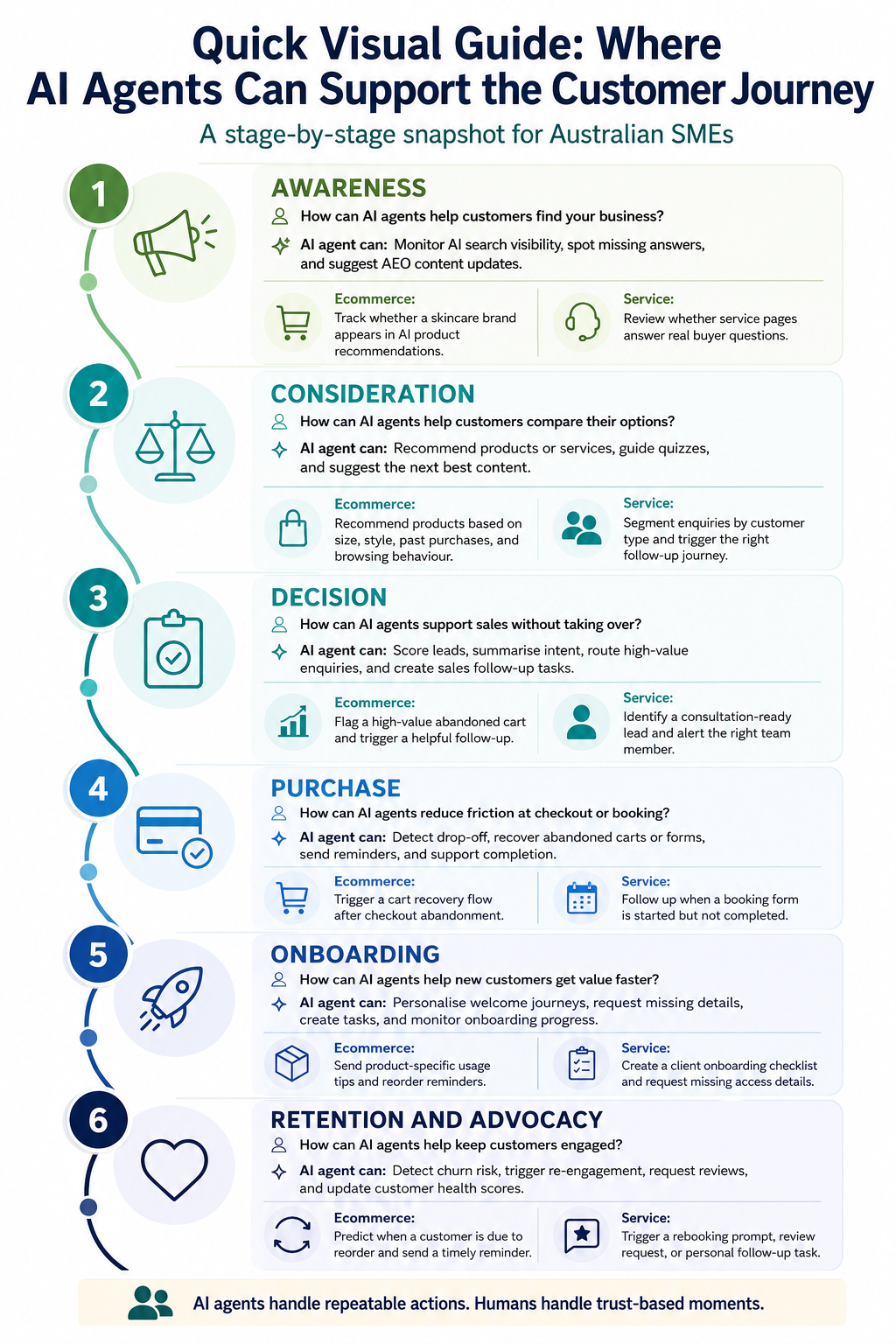
This guide breaks down the customer journey into six stages and shows where AI agents can be useful, where they should be used carefully and where humans still need to lead.
An AI agent is a system that can take action based on a goal, instruction or customer signal.
In a customer journey, an AI agent may help:
For example, a standard AI tool may help write an email. An AI agent could identify which customer should receive the email, personalise the message, trigger the send, update the CRM and alert the team if the customer replies. All without human intervention.
Customer behaviour is changing quickly.
AI tools are already influencing how people search, compare and buy. In research conducted by eMarketer, nearly 42% of shopping experiences already involved AI tools, and 19% of customer journeys started inside an AI assistant.
The same research found that 85% of surveyed buyers use AI at least weekly, and 43% have discovered a new brand through AI. That means customers are no longer only using traditional channels to find your business.
They may be asking AI tools for recommendations before they ever visit your website. They may be comparing your business against competitors through an AI assistant. They now expect faster answers, more relevant follow-up and less friction.
For SMEs, this creates two clear priorities.
First, your business needs to be understandable to AI systems.
Second, your customer journey needs to be connected enough for AI agents to act on the right data.
AI agents are most useful when they help customers or teams take the next step or help your team provide support more quickly. Here are some examples for each stage of the journey
The awareness stage is where customers first discover your brand, product or service.
This used to happen mainly through Google search, paid ads, social media, referrals and local search.
Now, customers may also discover businesses through AI-generated answers in tools like ChatGPT, Gemini, Perplexity and Google AI Overviews.
This means your content needs to be clear enough for people, search engines and AI assistants to understand.
Use AI agents at this stage when you want to monitor, improve and act on how your brand appears across AI search and answer engines.
This is especially useful if your business relies on:
An AI agent could help:
For example, an AI agent could regularly check what AI tools say when someone asks:
“What is the best marketing automation agency for Australian ecommerce brands?”
“Who can help set up ActiveCampaign for a service business?”
“What is the difference between SEO and AEO?”
If your business is missing, described poorly or not being cited, the agent can flag what content needs to be improved.
An ecommerce brand selling skincare could use an AI agent to monitor common AI search questions, such as:
“What skincare products should I use for dry skin?”
“What is the difference between a serum and a moisturiser?”
“How do I build a simple skincare routine?”
The agent could identify whether the brand is being surfaced, which competitors appear more often and what content needs to be improved.
A service business could use an AI agent to review whether its website clearly answers buying questions, such as:
“When should a business move from spreadsheets to a CRM?”
“How can automation improve lead follow-up?”
“What should I look for in a digital marketing agency?”
The agent could then recommend content updates, FAQ additions or service page improvements.
Do not use AI agents to create large volumes of thin content.
AI visibility is not about publishing more pages for the sake of it. It is about creating clear, specific and useful answers that help customers understand whether your business is relevant to them.
AI agents should help improve content quality, not flood the website with generic content.
At the consideration stage, customers are actively comparing products, services, providers or solutions.
They may be reading reviews, checking prices, comparing features, viewing case studies or asking AI tools to help narrow their options.
In the source research, 57% of buyers used AI to narrow down their choices, 52% specified constraints such as budget or features during AI interactions, and 50% made a purchase after using AI during research.
This shows that AI is no longer just part of discovery. It is part of comparison.
Use AI agents when customers need help choosing between options or when your business needs to respond to different levels of intent.
This is useful for:
An AI agent could help:
For example, if a customer has visited the same product category three times, clicked a buying guide and added an item to cart, an AI agent could move them into a more relevant product education or offer journey.
A fashion retailer could use an AI agent to help customers find the right product based on:
The agent could recommend matching products, update the customer profile and trigger an email with the selected items.
A martial arts academy could use an AI agent to separate enquiries for kids, teens and adults.
A parent looking for a class for their child should receive different information from an adult looking for fitness, confidence or self-defence.
The agent could classify the enquiry, update the CRM and trigger the right email journey.
Do not force customers into an AI-only pathway.
The source research noted that 86% of buyers still verify AI recommendations through other channels.
This means your AI agent should help customers compare, but it should not block them from viewing pages, reading reviews or speaking with a person.
The decision stage is when a customer is close to taking action.
They may be ready to book, buy, enquire, sign up, request a quote or speak to sales.
At this stage, an AI agent can help identify intent, prioritise leads and make sure the right follow-up happens quickly.
This is where AI agents can be very useful for businesses that lose opportunities because follow-up is slow, inconsistent or too generic.
Use AI agents when you need to identify which customers are most likely to convert and what they need next.
This is especially useful when your team cannot manually review every lead, abandoned cart, quote request, booking enquiry or form submission.
An AI agent could help:
For example, if someone views a pricing page, reads a case study and submits an enquiry, the agent could flag the lead as high intent, summarise the customer’s activity and create a follow-up task for the team.
An online furniture store could use an AI agent to identify buying intent.
Signals may include:
The agent could then trigger a helpful follow-up, recommend related content or alert customer support if the cart value is high.
A cosmetic clinic could use an AI agent to separate early research from decision-stage intent.
Someone reading an introductory blog may need education.
Someone checking pricing, viewing before and after content and submitting a consultation form may need a fast human follow-up.
The agent can classify the enquiry and route it correctly.
Do not let AI agents fully handle high-trust decisions.
The source research found that 74% of consumers would trust an AI agent to handle routine purchase tasks, but only 9% were open to fully autonomous purchases by an AI agent. Payments were also noted as a major barrier.
This means AI agents can support the decision, but they should not replace human reassurance where the customer needs confidence, trust or expert advice.
At the purchase stage, the goal is to make it easy for the customer to complete the action.
This may be buying a product, booking a call, signing up for an event, paying a deposit, completing a form or finishing checkout.
AI agents are useful here when they remove effort.
They are not useful when they interrupt the customer.
Use AI agents when they make the purchase, booking or payment process faster, clearer or easier.
This is useful for:
An AI agent could help:
For example, if a customer starts a booking form but does not complete it, an AI agent could send a helpful reminder, check whether the customer needs support and alert the team if the booking value is high.
A homewares brand could use an AI agent to recommend complementary products before checkout, such as matching cushions, throws or care products.
The agent could also trigger a cart recovery email if the customer leaves before completing the order.
A travel business could use an AI agent to detect incomplete booking forms, send a follow-up with helpful information and notify the reservations team when a high-value enquiry is at risk of dropping off.
Do not add unnecessary AI-powered steps at checkout.
The source draft includes a clear rule for this stage: the goal is removal, not addition.
If a customer is ready to pay, avoid extra pop-ups, chat prompts or recommendation tools that interrupt the transaction.
An AI agent should help behind the scenes unless the customer clearly needs support.
The onboarding stage starts immediately after someone becomes a customer.
This is where the customer needs clear next steps, useful information and reassurance that they made the right choice.
AI agents can make onboarding more relevant by using what the customer bought, booked, enquired about or selected.
The source draft noted that AI-powered onboarding has been linked to 30% to 60% reductions in time-to-activation and 5% to 15% activation or conversion uplift.
Use AI agents when different customers need different onboarding journeys.
This is useful for:
An AI agent could help:
For example, if a client starts with a CRM migration, the agent could create an onboarding checklist, request access details, send the right welcome email and alert the team if key information is missing.
A supplement brand could use an AI agent to send different onboarding content based on the product purchased.
A starter bundle customer may need usage guidance, FAQs and reorder reminders.
A repeat customer may need product education, loyalty content or complementary product recommendations.
A digital agency could use an AI agent to prepare a client onboarding handover.
The agent could summarise the sales conversation, identify the services purchased, create internal tasks and send the client a clear next steps email.
This is where AI agents can be useful for both the customer and the team.
Do not make onboarding feel cold or generic.
AI agents can reduce admin, but they should not remove human contact where trust is still being built.
For service-based businesses, the best onboarding journey often combines automation with a clear human check-in.
Retention is where AI agents can be highly useful because customer behaviour often changes before a customer leaves.
A customer may stop opening emails, delay repeat purchases, reduce bookings, stop logging in or stop responding.
AI agents can help detect these patterns earlier and trigger the right action.
In the source draft, examples included behavioural stage detection producing a 75% lift in email click-through rate, AI-enhanced journey mapping contributing to a 47% conversion lift and AI-optimised CTAs producing a 2x conversion lift.
Use AI agents when you want to identify churn risk, increase repeat purchases or encourage happy customers to leave reviews, refer friends or provide testimonials.
This is useful for:
An AI agent could help:
For example, if a customer usually buys every 60 days and has not purchased in 90 days, an AI agent could trigger a relevant reminder before they fully disengage.
A pet food brand could use an AI agent to predict when a customer may be ready to reorder.
Instead of sending the same promotion to the full list, the agent could trigger reminders based on previous purchase timing.
A clinic, academy or agency could use an AI agent to identify when a customer or client has stopped engaging.
The agent could trigger a check-in email, a rebooking reminder, a review request or a task for the team to follow up personally.
Do not treat every inactive customer the same.
Some customers need a reminder. Some need support. Some need a better offer. Some may no longer be the right fit.
AI agents should help your business understand the difference so the follow-up feels relevant.
AI agents can support many parts of the customer journey, but they should not manage every interaction on their own.
If a customer is upset, frustrated or dealing with a sensitive issue, an AI agent should not be the main response.
AI can help detect negative sentiment, summarise the issue and route the enquiry.
A human should handle the conversation.
Some decisions involve cost, risk, identity, personal preference, family or long-term commitment.
In these moments, an AI agent can support the process, but a person may still need to provide reassurance.
AI agents work best when the task is clear, repeatable and connected to structured data.
They are less reliable when the issue is unusual, emotionally charged or requires judgement.
In these cases, the AI agent should collect details, summarise history and route the issue to the right person.
AI agents should not make final decisions on refunds, cancellations, complaints, legal issues or sensitive account changes unless there are clear rules and human oversight.
The safer approach is to let the agent prepare the information and recommend the next step, while a human approves the action.
AI agents are only useful when they are connected to the right systems and data.
For most SMEs, this may include:
Without these connections, an AI agent is limited.
It may be able to answer questions, but it cannot act properly across the customer journey.
This is why AI agents should be planned as part of a customer journey system, not added as a disconnected tool.
You do not need to build AI agents across the full customer journey at once.
Start with one stage where there is a clear problem or opportunity.
For example:
The best AI agent strategy is not the one with the most automation.
It is the one that solves the right customer journey problem first.
Walk Digital helps Australian businesses identify where AI agents, automation and human support should work together across the customer journey.
This may include:
The goal is not to add AI everywhere.
The goal is to build a smarter customer journey where AI agents handle the repeatable work, and your team focuses on the moments that need human judgement.
AI agents can help Australian SMEs create faster, more relevant and more connected customer journeys.
They can monitor, recommend, qualify, route, trigger, summarise and follow up.
But they need the right strategy, data and boundaries.
AI agents are most effective when they are connected to your customer journey, not sitting outside it.
They should reduce manual work, improve customer experience and help your team act faster.
AI agents handle the repeatable actions.
Humans handle the trust-based moments.
AI agents in the customer journey are systems that can take action based on customer behaviour, data or instructions. They can help qualify leads, personalise communication, update CRM records, trigger workflows, route enquiries and support customers across different stages of the journey.
Standard AI tools usually help generate, summarise, recommend or analyse. AI agents can complete tasks and move a process forward. For example, a standard AI tool may write an email, while an AI agent could decide who should receive it, personalise it, send it through an automation platform and update the CRM.
AI agents can be used in AI search monitoring, lead qualification, customer segmentation, product recommendations, email automation, abandoned cart recovery, onboarding, retention, review requests and reporting.
Yes. Ecommerce businesses can use AI agents for product recommendations, cart recovery, reorder reminders, customer segmentation, personalised email flows, review requests and loyalty campaigns.
Yes. Service businesses can use AI agents to qualify enquiries, route leads, personalise follow-up, create onboarding tasks, request missing information, monitor client engagement and support rebooking or retention workflows.
AI agents should not fully replace customer service teams. They are best used for routine tasks, simple questions, routing, summaries and workflow support. Human support is still needed for complaints, complex issues and high-trust decisions.
AI agents work best when they are connected to clean customer data. This may include CRM records, website behaviour, purchase history, email engagement, booking data, support history and customer segments.
A business should start with one clear customer journey problem. This may be slow lead follow-up, poor onboarding, abandoned carts, inactive customers or manual admin. Once the problem is clear, an AI agent can be designed to support that specific workflow.

.svg)


Chris Walker has helped companies find the right digital solutions to achieve their business goals for more than 15 years and has worked with almost all the key digital platforms across the whole space.
He is a Meta and Google Ads Expert, as well as a certified ActiveCampaign Consultant and klaviyo partner. He has a broad range of experience including digital strategy, content creation, strategic partnerships, marketing automation and digital advertising. He has helped businesses redesign their customer journey and content, resulting in increased sales and conversion and drive more traffic.