


25
February
,
2026

Chris Walker
You've got Klaviyo humming away in the background, tracking clicks, purchases, and email opens like a champion. Your data's all there. But here's the problem: you're drowning in dashboards.
You don't have time to dig through reports, decode segment logic, or become a prompt engineer just to figure out which customers are about to churn. You need answers fast: preferably in plain Eng-lish.
Good news: Klaviyo's AI features (and tools like ChatGPT) are finally making it possible to have an actual conversation with your data. No SQL degree required.
In this guide, I'll show you exactly how to talk to Klaviyo AI like a pro, so you can get instant insights, build smarter campaigns, and stop wasting time buried in spreadsheets.
You're time-poor. You've got a thousand tabs open and you need to make a quick call on whether to send a campaign today or wait until Friday.
The problem isn't the data: it's how you access it. Traditional platforms force you to manually build segments, filter reports, and decode metrics. It's exhausting.
That's where natural language AI changes the game. Instead of navigating complex menus, you just describe what you need. Klaviyo's Segments AI and conversational tools like ChatGPT let you ask questions like a human and get answers like a data analyst.
It's digital marketing for small business owners who'd rather focus on strategy than spreadsheets.
Here's the truth: AI is only as good as the instructions you give it. Most people write vague, wishy-washy prompts and then wonder why the output is rubbish.
Follow these three rules, and you'll get better results every single time.
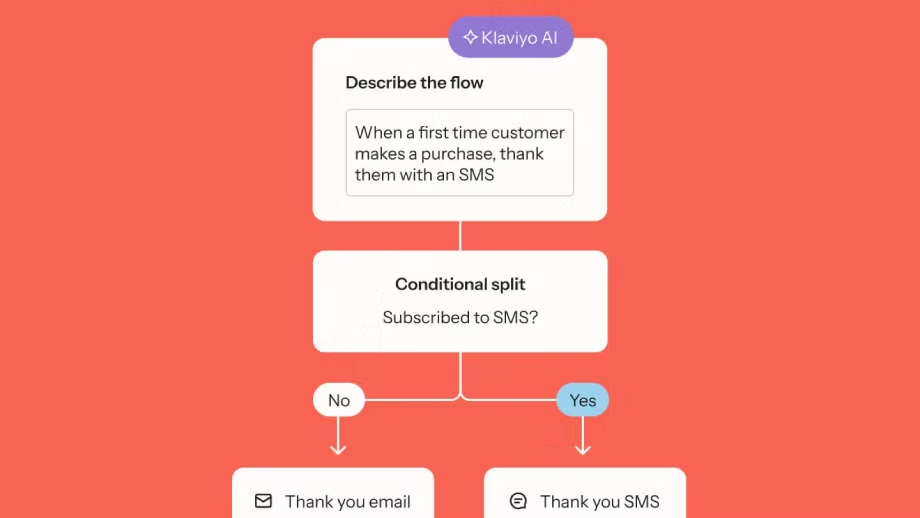
AI doesn't need you to be polite or creative. It needs you to be specific.
"Can you help me understand my email performance
"Show me open rates, click rates, and revenue for all email campaigns sent in January 2026. Compare to December 2025."
See the difference? The second prompt tells the AI exactly what to deliver. No guessing, no wasted output.
AI doesn't know your business. You need to give it context so it understands what matters.
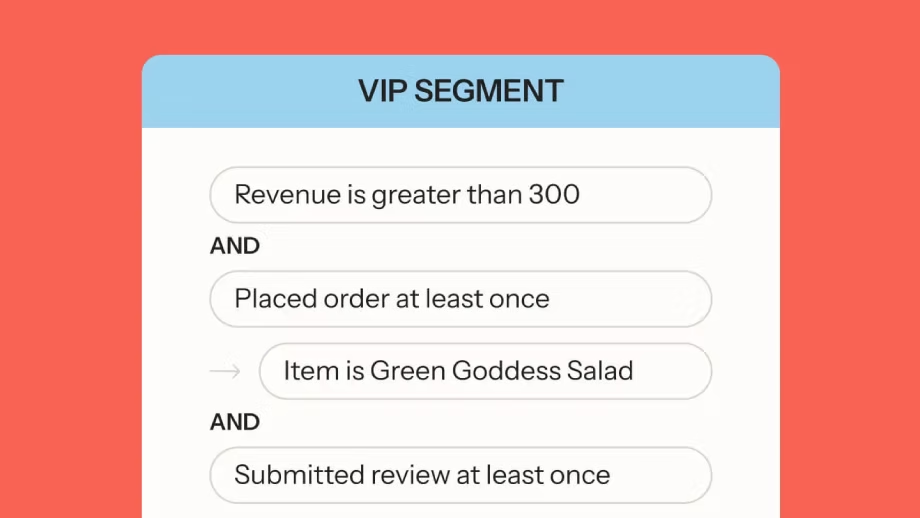
"Create a segment for high-value customers."
"Create a segment of customers who spent over $500 in the last 90 days, opened at least 3 emails, and haven't purchased in the last 30 days. I want to send them a VIP discount."
The more context you provide (timeframes, behaviours, goals), the better the AI performs. This is especially critical when using Klaviyo's predictive analytics to forecast churn or lifetime value.
Don't just ask for data: ask for a recommendation or next step.
"What's my cart abandonment rate?"
"My cart abandonment rate is 68%. Suggest three automated flow improvements to reduce this by 15% in the next 60 days."
This shifts the AI from reporter to strategic advisor. It's the difference between getting a number and getting a plan.
Here's a collection of ready-to-use prompts organised by task type. Copy, tweak, and deploy these in your Klaviyo dashboard or via ChatGPT integrations.
Use these to pull insights fast without clicking through endless tabs.
These help you make smarter decisions about who to target and when.
This is where Klaviyo's Segments AI really shines. Instead of manually building filters, you describe the audience in plain English, and the platform does the heavy lifting.
Use AI to speed up content creation and testing.
Pro tip: If you're running a B2C marketing strategy with frequent promotions, AI-generated content saves hours every week. Just make sure you review it before sending: AI isn't perfect (yet)
Let's talk about the elephant in the room: AI sometimes lies.
It's called "hallucination," and it happens when AI confidently delivers information that's completely made up. This is especially dangerous when you're making business decisions based on those out-puts.
Here's how to catch and fix it
If AI tells you your open rate is 45% but your dashboard says 32%, trust the dashboard. Always verify key metrics manually.
When using tools like ChatGPT, ask: "Where did you get this data?" or "Show me the calculation." If it can't explain, the number might be dodgy.
Vague timeframes ("recently," "last month") confuse AI. Always use exact dates: "January 1–31, 2026."
If AI builds a segment for you, preview the customer list before you launch a campaign. Make sure the logic matches your intent. Klaviyo's Segments AI is powerful, but you're still the strategist.
Treat AI as your research assistant, not your CEO. It's great at generating options, spotting patterns, and drafting copy: but the final call is always yours.
At Walk Digital, we help SMEs set up Klaviyo implementations that combine AI power with human strategy. Because at the end of the day, tools don't win campaigns: smart decisions do
Here's the thing most people get wrong: they obsess over the tech and forget about the strategy.
Klaviyo AI can predict churn, personalise send times, and generate email copy. But if you don't have a clear key messaging customer journey map or a solid email marketing strategy, AI won't magically fix your campaigns.
AI amplifies what you already do.
If your flows are broken, AI will help you break them faster. If your segmentation is lazy, AI will give you lazy results. If your integrations are not working correctly, automations won’t trigger.
That's why at Walk Digital, we always start with strategy first:
Once we've mapped that out, then we deploy AI to automate, optimise, and scale. It's the difference between throwing spaghetti at the wall and building a system that actually works.
If you want to start having real conversations with your data, it's time.
At Walk Digital, we specialise in helping Australian businesses unlock the full power of Klaviyo's AI tools: from predictive analytics to automated flows that actually convert.
Whether you need help setting up Segments AI, building smarter nurture sequences, or integrating Klaviyo with your existing stack, we've got you covered.

.svg)


Chris Walker has helped companies find the right digital solutions to achieve their business goals for more than 15 years and has worked with almost all the key digital platforms across the whole space.
He is a Meta and Google Ads Expert, as well as a certified ActiveCampaign Consultant and klaviyo partner. He has a broad range of experience including digital strategy, content creation, strategic partnerships, marketing automation and digital advertising. He has helped businesses redesign their customer journey and content, resulting in increased sales and conversion and drive more traffic.