


24
July
,
2026

Georgia Hull
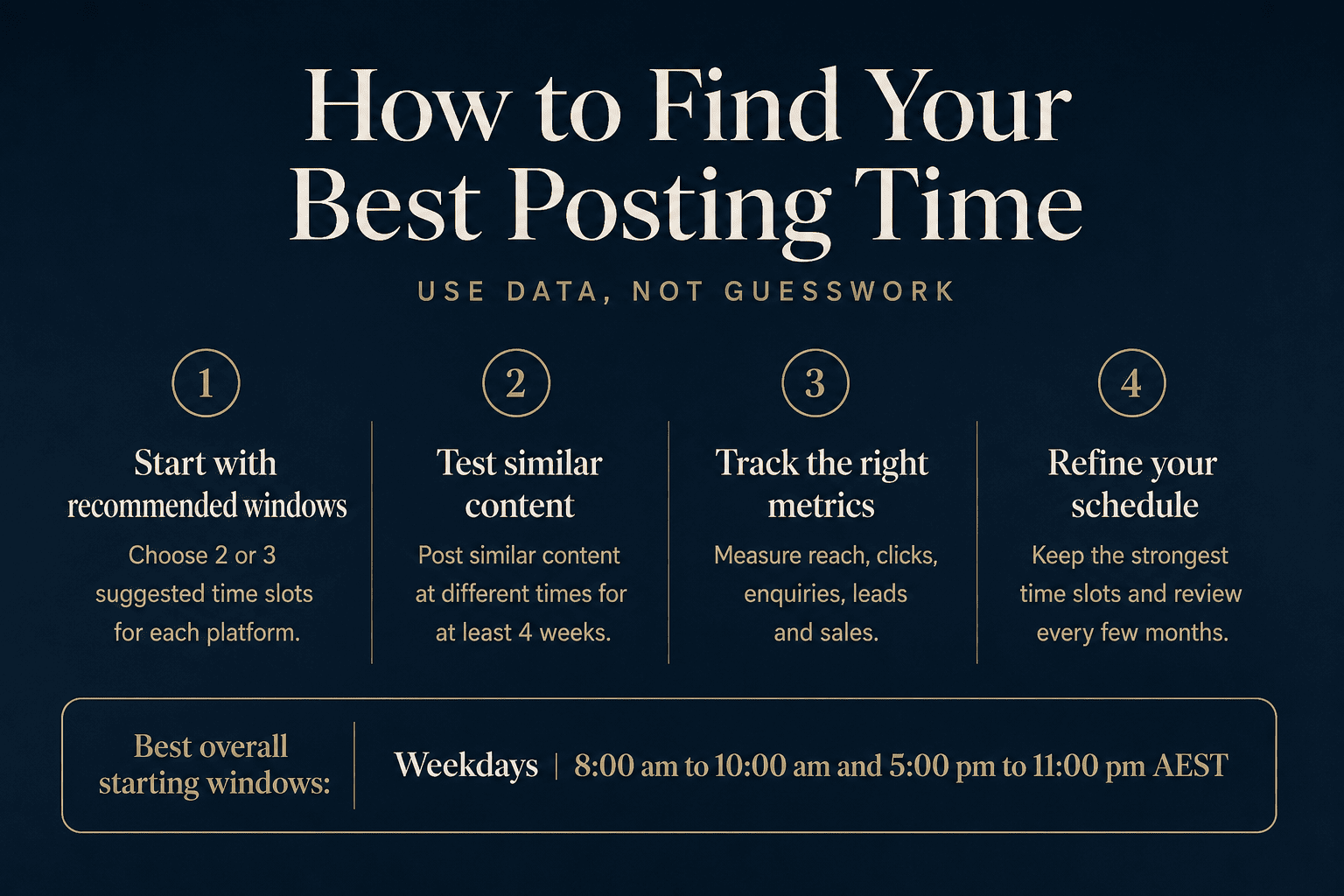
For Australian audiences, the strongest general posting windows are weekdays between 8:00 am and 10:00 am and between 5:00 pm and 11:00 pm AEST.
Thursday produces the highest engagement across most platforms, while Saturday is generally the weakest day. Tuesday to Thursday remains the most reliable part of the week for important content. (Sprout Social)
However, there is no single time that suits every business.
LinkedIn follows working-day habits. Facebook and Instagram attract more post-work browsing. TikTok can see several short activity spikes throughout the day.
Use the times below as a starting point, then compare them with your own account data.
These recommendations are not based on a small survey or a handful of websites.
Sprout Social’s Australian study analysed more than 68 million Australia-specific brand engagements across Facebook, Instagram, LinkedIn, TikTok, X and Pinterest. Its broader global study reviewed nearly 2 billion engagements across approximately 307,000 social profiles from more than 30,000 customers. (Sprout Social)
Buffer’s latest Instagram study analysed 9.6 million individual posts. It found that Wednesday was the strongest day overall, with weekday evening activity also performing well across most days. (Buffer)
These large datasets provide a useful baseline. They cannot predict exactly how your customers will behave, so your own reach, clicks, enquiries and sales should still guide your final schedule.
The following times are practical starting points for Australian audiences if your objective is conversions.
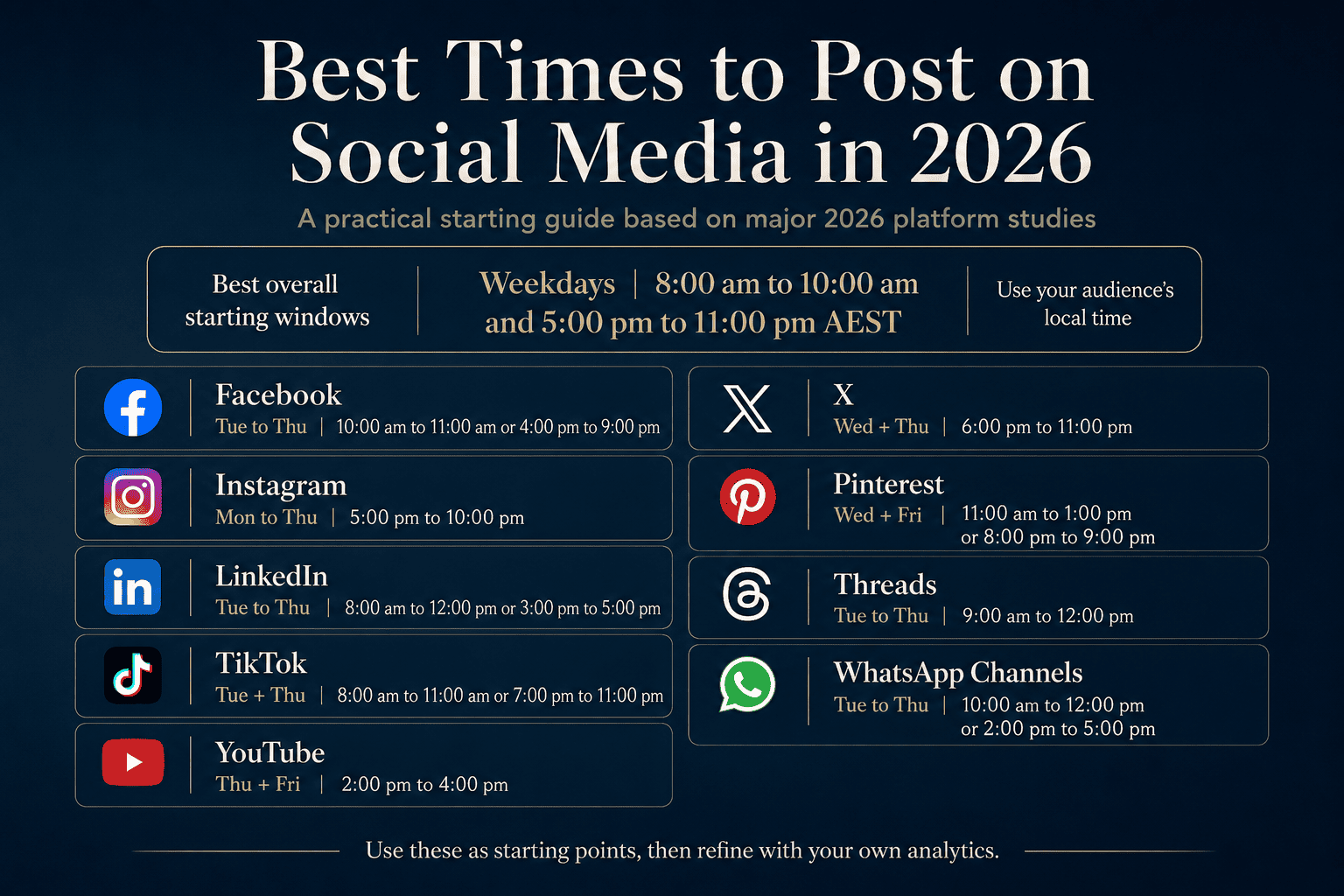
The Australian times for Facebook, Instagram, LinkedIn, TikTok, X and Pinterest come from Sprout Social’s local engagement study. The YouTube window is supported by Loomly’s broader platform analysis. Threads and WhatsApp should be treated as testing windows because there is less consistent large-scale Australian timing data available. (Sprout Social)
Sunday evening has extremely high reach and is a great day to get high awareness and high reach of eyeballs. But people are in relaxed mode and buyer intent has been seen to be lower, so in terms of converting to sale it is not the strongest period across the whole week. But for awareness it is hard to beat.
Australian data shows the best Sunday evening activity on several platforms:
Buffer also found that 9:00 pm was Instagram’s strongest Sunday time and its best weekend window. (Sprout Social)
A high proportion of people browse casually on Sunday evening as they relax or prepare for the week ahead.
That can create a useful audience window for:
However, high browsing activity does not automatically mean stronger buying intent.
Most posting-time studies measure reach, views or engagement. They do not prove that a particular time will generate more enquiries or sales. Compare website clicks, leads, add-to-cart activity and revenue before making Sunday evening a major part of your schedule.
For Australian Facebook audiences, start by testing Tuesday to Thursday between 4:00 pm and 9:00 pm.
A shorter morning window around 10:00 am to 11:00 am can also work during the week.
Australian engagement is heavily concentrated after work, when people are catching up with friends, community groups and local content. Sunday has a brief 7:00 pm to 8:00 pm window, but it remains one of Facebook’s weaker days overall. (Sprout Social)
For Australian audiences, Instagram performs most consistently between 5:00 pm and 10:00 pm from Monday to Thursday.
This differs slightly from Buffer’s global findings, which identified Thursday at 9:00 am and Wednesday at 12:00 pm and 6:00 pm as the top individual time slots. Buffer still found that evenings between 6:00 pm and 11:00 pm performed strongly across most weekdays. (Sprout Social)
A practical Instagram schedule is:
LinkedIn continues to follow professional working habits.
Australian businesses should test:
Morning posts suit business updates, guides and industry news. Afternoon posts can work for case studies, opinions and discussion-based content.
Australian data also shows some Saturday morning activity, but weekday business hours remain the safer starting point for B2B content. (Sprout Social)
TikTok has a less predictable activity pattern than other platforms.
Australian data shows several short windows across the day, particularly on Tuesday and Thursday. Useful starting periods include:
Late-evening activity can work for entertainment and consumer content. Business and educational videos may perform earlier when people are taking breaks or commuting. (Sprout Social)
Start by testing YouTube uploads on Thursday and Friday between 2:00 pm and 4:00 pm.
This gives longer videos time to gain initial views before evening and weekend viewing increases. YouTube Shorts may perform later, with Buffer finding strong Friday afternoon and evening results. (Loomly)
Timing can support early views, but your topic, title, thumbnail and audience retention will usually have a greater effect over time.
Australian activity on X is concentrated in the evening, particularly between 6:00 pm and 11:00 pm.
This suits news, sport, live events and real-time commentary. Post while the topic is active rather than waiting for a standard scheduled time. (Sprout Social)
Pinterest performs well around:
Evening Pinterest use is more deliberate than casual scrolling. People are often planning meals, outfits, travel, renovations and future purchases. (Sprout Social)
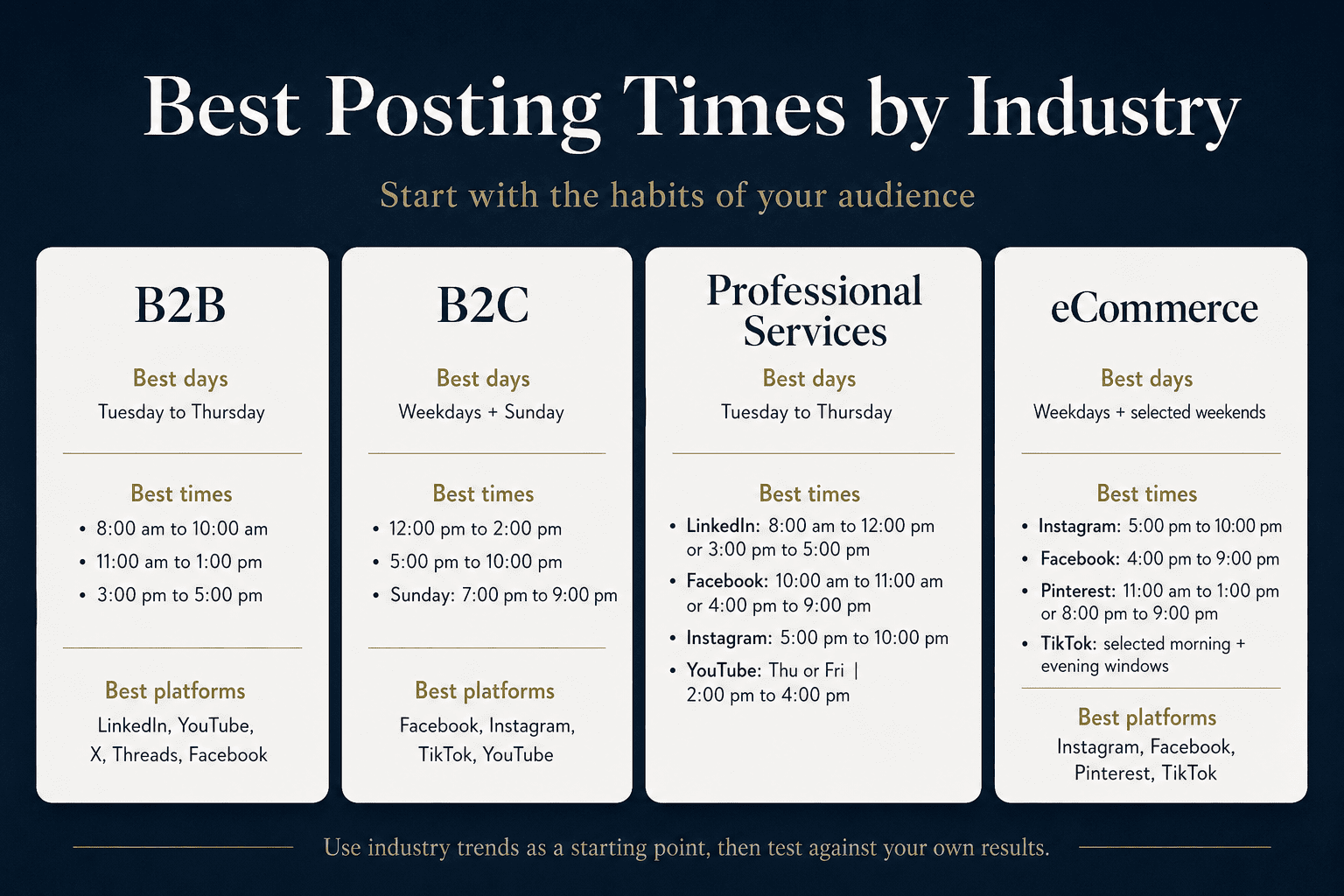
B2B businesses should focus on Tuesday to Thursday.
Test:
LinkedIn should usually be the main platform, supported by YouTube, X, Threads and selected Facebook content.
Case studies, client outcomes, research and practical advice are well suited to these periods.
B2C businesses should give more attention to evenings.
Start with:
Facebook, Instagram, TikTok and YouTube are usually the main platforms.
Product demonstrations, reviews, offers and customer content often suit post-work browsing.
Professional services businesses should concentrate their strongest content between Tuesday and Thursday.
A practical starting schedule is:
Content should answer customer questions, explain processes and show how your business solves real problems.
eCommerce brands should test:
Do not judge performance only by likes. Track product-page visits, add-to-cart actions, purchases and revenue from social traffic.
No. Schedule content around your audience’s location.
The Australian study reports its results in AEST. Businesses targeting Perth, Adelaide, Darwin or audiences affected by daylight saving should adjust their schedules rather than posting every message at the same national time. (Sprout Social)
National businesses can:
Choose two or three recommended windows for each platform and test similar content for at least four weeks.
Compare:
Meta Business Suite can show recent active follower times, while social media management platforms can recommend publishing windows using historical account engagement. (Sprout Social)
The time that receives the most likes may not be the time that brings the most customers.
No.
Good timing can help your post receive early attention, but it cannot fix content that is unclear, repetitive or irrelevant.
Strong social results come from combining:
Use large-scale data to choose your first posting times, then replace broad assumptions with your own results.
For Australian businesses:
Review your results every few months as audience habits and platform behaviour change.
Walk Digital can help turn your social media data into a clear content and advertising plan.
Our related services include:
We can review which platforms, posting times and content formats are producing meaningful results, then recommend where to focus your time and budget.
Contact Walk Digital to discuss a social media strategy built around your audience and business goals.

.svg)


Georgia is a marketer with over 15 years specialising in automation, driving revenue and brand awareness. Achieving growth by implementing strategies designed to drive customers to action from first contact along a journey through repeat purchase then on to passionate advocacy. She has experience working in challenging industries delivering consistent increased revenue and profits, with a focus on exceeding targets.
Specialties: Digital Advertising, marketing automation, segmentation and personalisation, content strategy, customer nurture, customer journey mapping, digital strategy, conversion tracking, database acquisition, CRM, process management, analytics.