


29
May
,
2026

Georgia Hull
AI tools recommend businesses they can clearly understand, explain and trust.
They do not select websites in the same way Google ranks search results. Instead, they look for clear service information, useful answers, strong website structure and proof that the business knows what it is doing.
If your website is vague, hard to interpret or missing key answers, AI tools may recommend a competitor instead - even if your business is a good fit.
Improving your website for AI discoverability helps AI tools understand when to mention your business, what you offer and who you are best suited to help
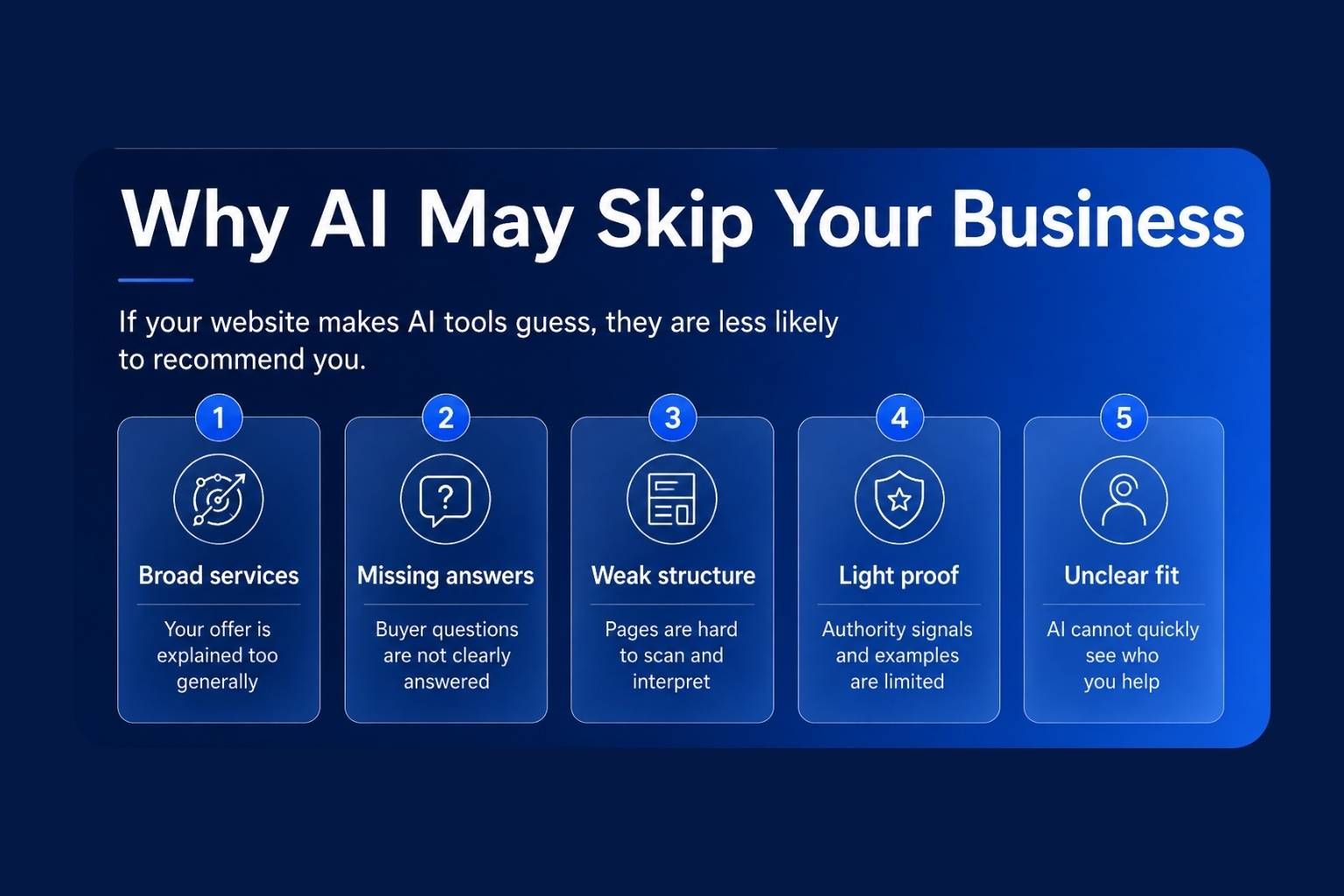
Your business may not be appearing in AI recommendations because your website does not make your expertise clear enough.
This often happens when:
AI tools need clear information to work with.
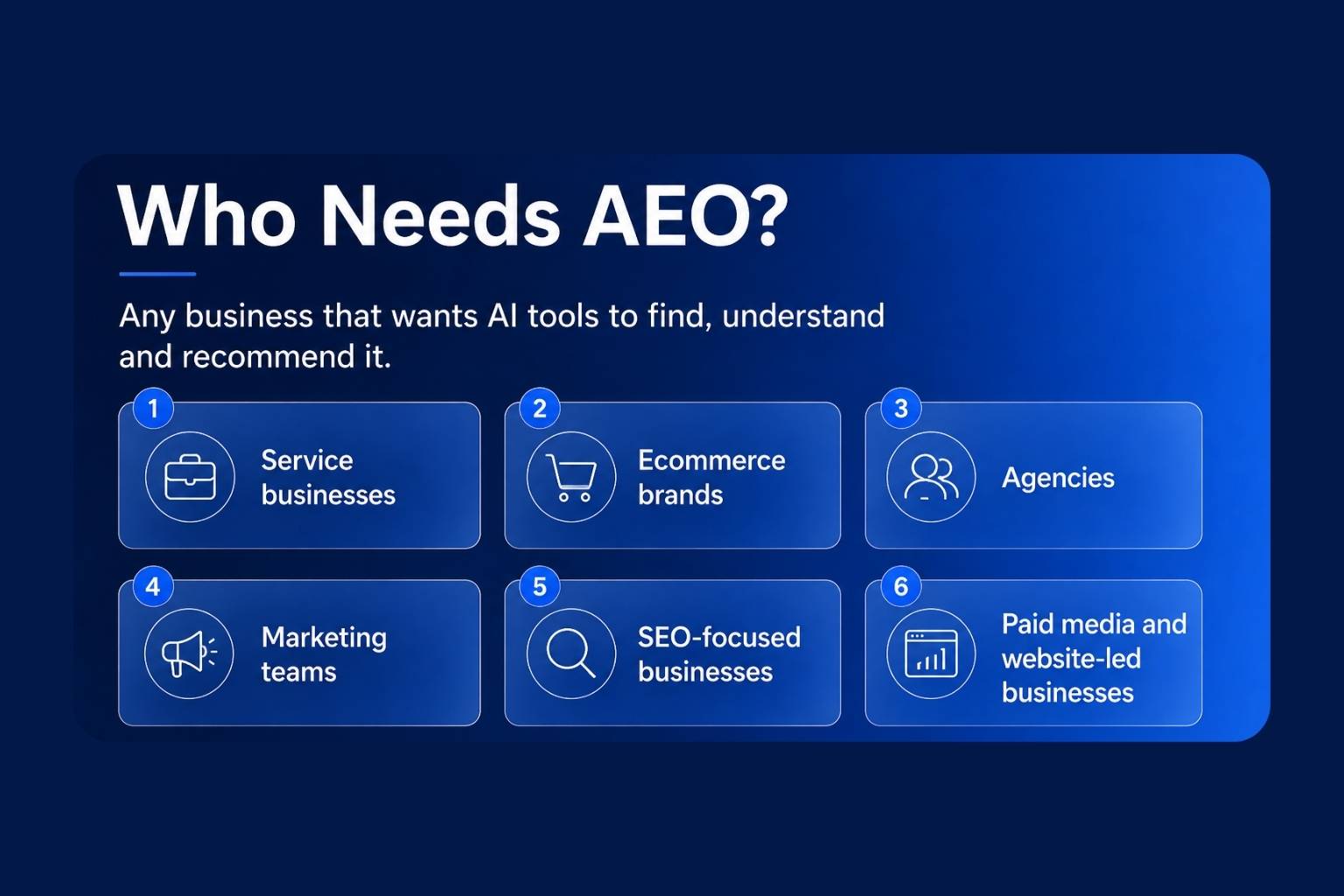
AEO and AI discoverability are useful for businesses that want to be found, understood and recommended by AI tools.
This includes:
If people are starting to ask ChatGPT, Perplexity, Gemini or other AI tools for recommendations in your category, your website needs to be easy for those tools to understand.
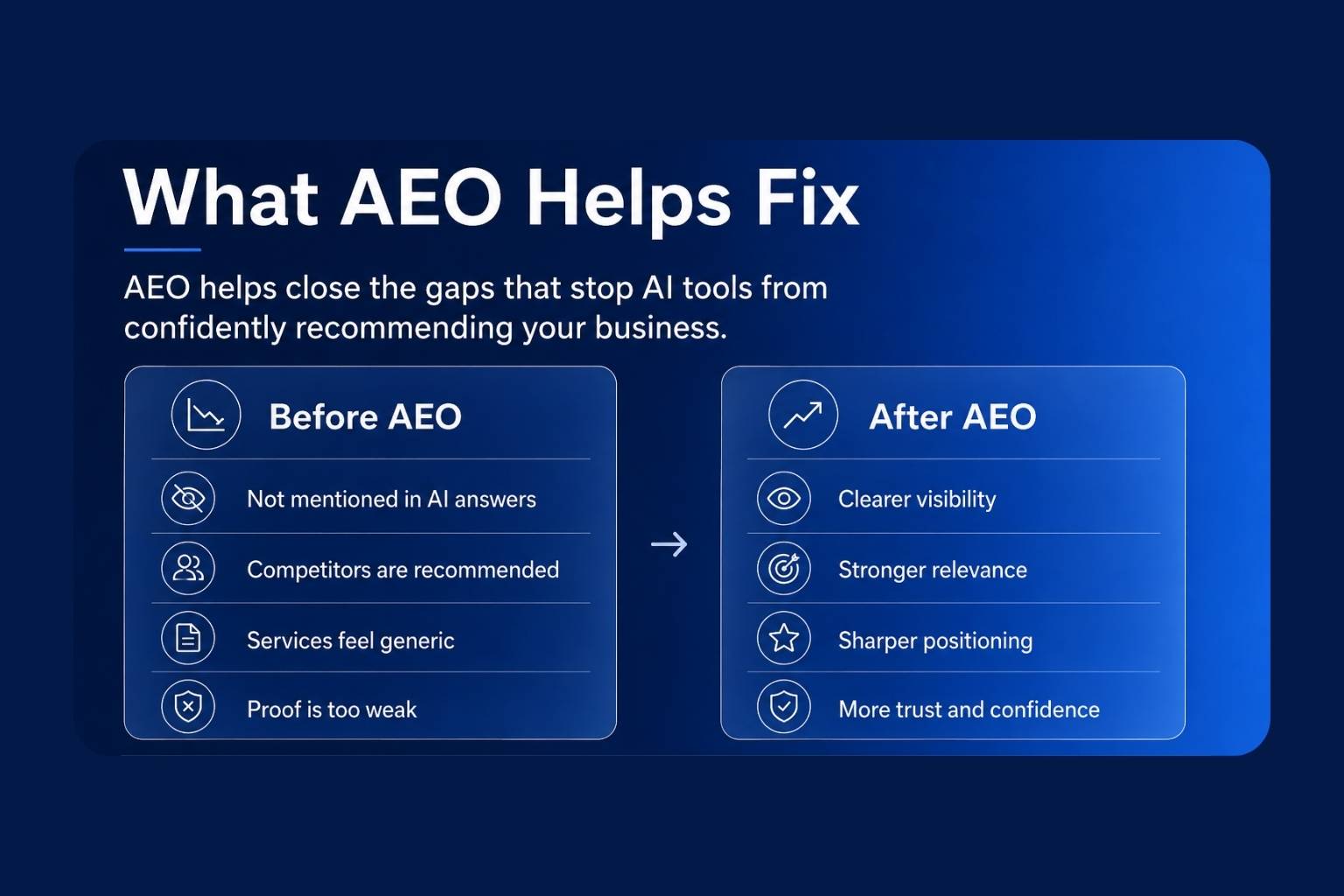
AEO helps fix the gaps that stop AI tools from confidently recommending your business.
The most common problems include:
The goal is not just to increase visibility. The goal is to make your business easier to understand, easier to trust and easier to recommend.
AI tools usually assess four key areas before deciding which businesses to mention.
AI tools need to quickly understand:
If this information is unclear, buried or written in vague language, your business is less likely to be selected.
A strong AEO page explains your service clearly at the top of the page, then supports it with more detail below.
AI tools favour content that gives direct, useful answers.
This includes:
For example, a buyer may ask:
If your website answers these types of questions clearly, AI tools have more useful information to draw from.
AI tools need structure to understand your content.
AEO-friendly pages usually include:
Good structure helps both people and AI tools understand what each page is about.
AI tools are more likely to recommend businesses that show clear signs of expertise and trust.
Authority signals can include:
For example, if your agency says it works across CRM, ecommerce and paid media, your website should support that claim with clear service pages, examples, outcomes and relevant content.
When your website is structured for AI discoverability, it becomes easier for AI tools and potential customers to understand your business.
This can help:
AEO is not just about visibility. It is about making sure the right buyers understand your value faster.
Improving a website for AEO usually involves refining the way your content is written, structured and supported.
This can include:
The aim is to make your website easier for AI tools to read, categorise and recommend.
Walk Digital approaches AEO as a visibility and conversion problem.
That means the goal is not just to help your business appear more often. The goal is to help the right people understand your services and take action.
Walk Digital works across:
This means AEO improvements can be connected to the parts of your marketing that directly affect revenue, not just traffic.
Your website needs to be discoverable, but it also needs to convert the people who find it.
If your business is not being recommended by AI tools, the issue is usually not one single page or keyword.
It is usually a combination of clarity, structure, question coverage and authority.
An AEO Audit shows how AI tools are likely to interpret your website, where your content is unclear and what needs to be fixed.
If you want to improve how your business appears in AI recommendations, start by reviewing whether your website clearly answers:
The clearer these answers are, the easier it is for AI tools to understand and recommend your business.
They prioritise clarity, structure, and credibility.
SEO focuses on rankings. AI focuses on understanding and recommending.
Yes, if their content is clear and structured.
Changes can start impacting visibility within weeks.
Yes, but clarity and content structure are equally important.
Yes, if you know what to prioritise.

.svg)


Georgia is a marketer with over 15 years specialising in automation, driving revenue and brand awareness. Achieving growth by implementing strategies designed to drive customers to action from first contact along a journey through repeat purchase then on to passionate advocacy. She has experience working in challenging industries delivering consistent increased revenue and profits, with a focus on exceeding targets.
Specialties: Digital Advertising, marketing automation, segmentation and personalisation, content strategy, customer nurture, customer journey mapping, digital strategy, conversion tracking, database acquisition, CRM, process management, analytics.